
One of the biggest mistakes students make in mathematics is trying to memorize everything without understanding why it works.
Memorization may help you pass a quiz, but true understanding gives you something much more valuable: the ability to solve problems you have never seen before.
I often see this when teaching exponents. If I ask a high school student:
“What is 20⁰?”
Many students confidently answer:
“0”
When I ask why, the response is often:
“I don’t know. I just thought it was.”
This is not because the student lacks ability. It is usually because they have memorized rules without understanding the logic behind them.
One of my favorite examples in tutoring is showing students why any nonzero number raised to the power of zero equals one.
Once students understand the reason, they rarely forget it.
The Simple Logic Behind x⁰ = 1
In mathematics, rules are not meant to be accepted blindly. Most rules arise from patterns and logical reasoning.
One of the most important laws of exponents states that when dividing powers with the same base, we subtract the exponents:
xᵃ ÷ xᵇ = xᵃ⁻ᵇ
This rule works for any nonzero value of x.
Now consider what happens when we divide a number by itself:
xᵃ ÷ xᵃ
Since any nonzero number divided by itself equals 1, we know that:
xᵃ ÷ xᵃ = 1
But if we apply the law of exponents, we get:
xᵃ ÷ xᵃ = xᵃ⁻ᵃ
Since a − a = 0, this becomes:
x⁰
Therefore:
1 = xᵃ ÷ xᵃ = xᵃ⁻ᵃ = x⁰
This shows that:
x⁰ = 1
for every nonzero value of x.
Notice what happened here. We did not memorize a rule. We derived it from a rule we already knew.
For many students, this is a surprising moment. They realize that mathematics is not a collection of random facts. It is a system of ideas connected by logic.
Why Students Often Think 20⁰ = 0

When students are taught only to memorize rules, they often try to guess when they forget.
Some assume that since multiplying by zero gives zero, a number raised to the power of zero should also be zero.
Others simply remember hearing that “something about zero makes the answer zero.”
These misconceptions are understandable. Without the reasoning behind the rule, students are left with isolated facts that are easy to confuse.
Once students see the derivation, however, the confusion usually disappears. They can reconstruct the result themselves whenever they need it.
Understanding Versus Memorization
As a mathematics major, one of the most valuable lessons I learned was that mathematics is not primarily about solving problems. It is about understanding why mathematical ideas are true.
In advanced mathematics, we spend a great deal of time studying proofs, derivations, and logical arguments. The goal is not simply to obtain an answer but to understand where that answer comes from.
This approach develops stronger problem-solving skills because understanding allows us to apply concepts in unfamiliar situations.
Memorization may help for a short period of time, but understanding creates knowledge that lasts.
A Note for More Advanced Students
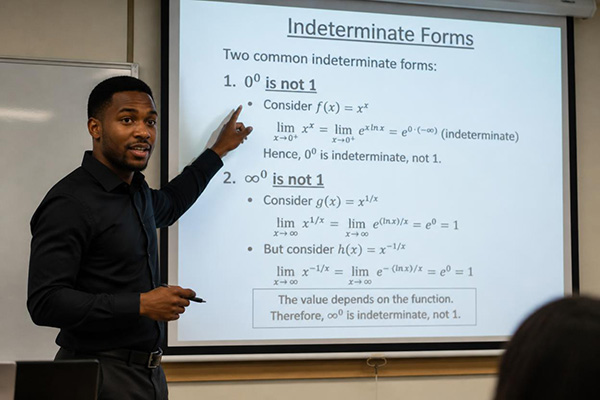
The statement that any nonzero number raised to the power of zero equals one is a fundamental result that follows directly from the laws of exponents.
However, mathematics also teaches us that context matters.
In more advanced courses such as calculus, students encounter expressions like 0⁰ and ∞⁰, which can appear as indeterminate forms in limit problems. These cases require careful analysis and should not be confused with the standard exponent rule for nonzero numbers.
For high school students, the important lesson is simple:
If x ≠ 0, then x⁰ = 1, and this result follows naturally from the laws of exponents.
Final Thoughts
One of the most rewarding moments in tutoring is watching a student realize that a mathematical rule is not something that must be memorized—it is something that can be understood.
When students discover for themselves why x⁰ = 1, they often react with surprise because the explanation is so simple.
That moment of understanding is what mathematics education should strive for.
When students understand the “why,” they no longer need to rely on memory alone. They gain something far more powerful: the ability to think mathematically.