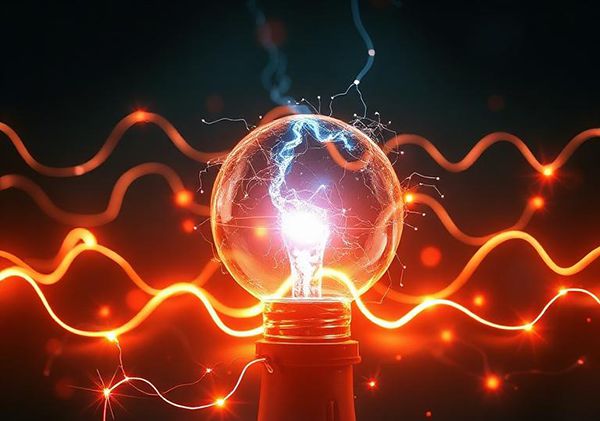
As a child, I was fascinated by one question: How does a light bulb produce light? Most children simply enjoyed switching a light on and off. I wanted to know what was happening inside the glass. That curiosity eventually led me to attempt something that, looking back, was both ambitious and wonderfully naïve—I decided to build my own light bulb. I was only nine years old. Building My Experiment Using whatever materials I could find around the house, I designed a simple experiment. I took two lead rods and attached an electrical wire to the bottom of each one. These wires would eventually connect to the terminals of a 9-volt battery. Next came the most important part of the experiment. From a bundle of ordinary electrical wire taken from an old appliance cable, I removed a very thin strand of wire. Using a sewing needle as a guide, I carefully wrapped the wire around it several times to create a tiny coil, or what is known in Physics as a solenoid. Once the coil was complete, I connected one end of it to the top of one lead rod and the other end to the second lead rod. To keep the rods standing upright and close together, I secured their bases with plasticine (commonly known in America as modeling clay). The entire setup was now ready. With great excitement, I connected the two wires to a 9-volt battery. The Moment of Truth The result was almost instantaneous. The tiny coil became extremely hot and immediately burnt out. It never produced the glowing light I had hoped to see. Surprisingly, I wasn't disappointed. I was excited. Although my homemade filament had failed, I had witnessed something important: electricity had generated enough heat to destroy the wire. To a nine-year-old mind, that meant I was closer than I had imagined. The experiment hadn't worked—but it had taught me something. What I Didn't Know Back Then Years later, after studying Physics, I finally understood why my experiment had failed. First, the wire I used was ordinary copper wire rather than tungsten, the metal used in traditional incandescent light bulbs because of its extremely high melting point. Second, I had no idea how to calculate the correct resistance of the filament. I never considered the thickness of the wire, the number of turns in the coil, or how much current a 9-volt battery would deliver. Finally—and perhaps most importantly—my experiment was performed in open air. A real incandescent bulb contains either a vacuum or an inert gas, such as argon. Without that protected environment, a hot filament quickly reacts with oxygen and burns out almost immediately. At nine years old, I couldn't possibly have known any of that. I simply wanted to see if I could make a wire glow. The Greatest Lesson Looking back today, I realize that the experiment was successful in a way I never appreciated at the time. No, I didn't build a working light bulb. But I learned something far more valuable. I discovered that science is not simply about reading facts from a textbook. It is about asking questions, testing ideas, making mistakes, and learning from every attempt. That tiny burnt coil taught me more about electricity than simply memorizing the parts of a light bulb ever could. Curiosity Is the Beginning of Science Children are naturally curious. They constantly ask "Why?" Unfortunately, as we grow older, many of us stop asking that question. I believe curiosity is one of the greatest gifts we can preserve. My homemade light bulb never illuminated a room. But it illuminated something much more important—a lifelong desire to understand how the world works. And perhaps that is what science has always been about.