Introduction
At first glance, the statement
0! = 1
looks completely wrong.
After all, factorials are products of whole numbers. For example:
5! = 5 × 4 × 3 × 2 × 1 = 120
4! = 4 × 3 × 2 × 1 = 24
3! = 3 × 2 × 1 = 6
2! = 2 × 1 = 2
1! = 1
But what happens when we reach 0!?
How can multiplying “nothing” somehow produce the value 1?
Many students encounter this fact and assume it is a mistake. However, not only is 0! equal to 1, it must equal 1 in order for mathematics to remain consistent.
Let’s explore why.
What Is a Factorial?

A factorial is a mathematical operation represented by an exclamation mark (!).
The factorial of a positive whole number n is the product of all positive integers from n down to 1.
Examples:
5! = 5 × 4 × 3 × 2 × 1 = 120
4! = 24
3! = 6
2! = 2
1! = 1
Factorials appear throughout mathematics, including probability, statistics, algebra, calculus, and computer science.
Looking for a Pattern
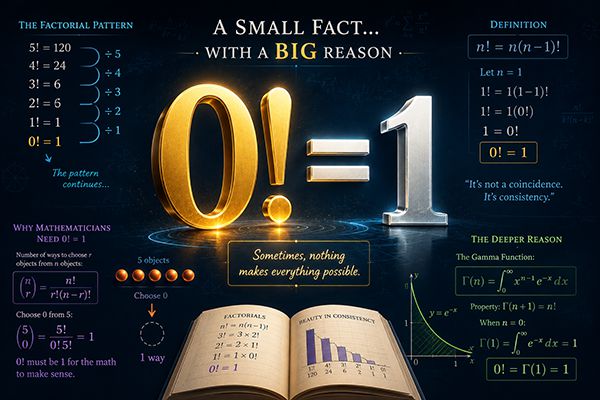
Let’s write the factorial values in descending order:
5! = 120
4! = 24
3! = 6
2! = 2
1! = 1
Notice that each step is obtained by dividing by the next whole number:
120 ÷ 5 = 24
24 ÷ 4 = 6
6 ÷ 3 = 2
2 ÷ 2 = 1
If we continue this pattern one more step:
1 ÷ 1 = 1
Therefore:
0! = 1
The pattern naturally leads us to the conclusion that 0! must equal 1.
While this is convincing, mathematicians prefer a more rigorous proof.
A More Formal Proof

One of the most important properties of factorials is:
n! = n(n − 1)!
This relationship works for all positive integers.
Let’s apply it when n = 1.
Substituting 1 for n gives:
1! = 1(1 − 1)!
Simplifying:
1! = 1(0!)
Since we already know that:
1! = 1
we obtain:
1 = 1(0!)
Dividing both sides by 1 gives:
0! = 1
Therefore, the only value that keeps the factorial formula consistent is:
0! = 1
Why Mathematicians Need 0! = 1
The definition is not arbitrary.
Many important mathematical formulas depend on 0! being equal to 1.
For example, combinations are calculated using:
nCr = n! / [r!(n − r)!]
Suppose we want to determine how many ways we can choose zero objects from five objects.
There is exactly one way: choose nothing.
Using the formula:
5C0 = 5! / [0!(5!)]
For the answer to equal 1, we must have:
0! = 1
If 0! were any other value, many formulas used in probability and statistics would break down.
An Advanced Calculus Connection
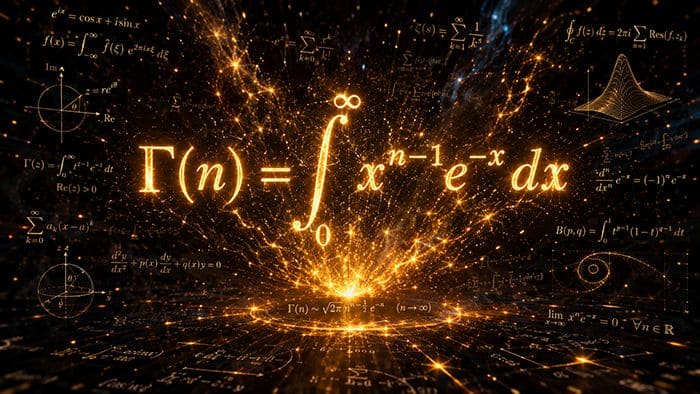
Students who study calculus eventually encounter the Gamma Function, which extends the factorial concept to non-integer values.
The Gamma Function is defined as:
Γ(n) = ∫₀∞ x^(n−1)e^(−x) dx
A remarkable property of the Gamma Function is:
Γ(n + 1) = n!
When n = 0:
Γ(1) = 0!
Evaluating the integral for Γ(1) produces:
Γ(1) = 1
Therefore:
0! = 1
This provides a deeper mathematical justification for the result.
Conclusion
Although the statement
0! = 1
may seem strange at first, it is one of the most important definitions in mathematics.
We can see it in three different ways:
• The factorial pattern naturally leads to 0! = 1.
• The recursive factorial formula requires 0! = 1.
• Advanced calculus confirms the result through the Gamma Function.
What initially appears to be a paradox turns out to be a beautiful example of how mathematical patterns remain consistent, even at the edge of what seems possible.
The next time you see 0!, remember that it isn’t an exception to the rules—it is exactly what the rules require.